Hello guys, today we would discuss one of the most frequently asked topic for those who are new to the usage of Mac OS that is, how to show and hide the hidden files in Mac OS X? Before we commence with the stupefying elaboration of WHAT TO DO? Let’s have a brief discussion on the aspect of this hidden folders and files in Mac OS X.
Nov 26, 2020 Other Useful Mac Features. In the remainder of this article, I'll discuss some useful features that are unique to Apple. Speak Time and Alerts. The Mac has speech capability that you can enable for various tasks, such as speaking the time on the hour or half-hour. It can also speak alerts from applications.
Actually by default, Mac OS prefers to hide confidential files and folders away from users. In case they delete or change any of those essential files mistakenly, then it would bring about serious changes to the system’s operating system which may turn out to be disastrous on many cases. Hence , here in this article we would discuss 2 mighty methods which are basically based on running certain commands, one via long way, and another using short cut aliases which are outlines below.
- On your Mac, choose Apple menu System Preferences, click Accessibility, then click Spoken Content. Select the “Speak selection” checkbox. By default, your Mac speaks text when you press the keyboard shortcut Option-Esc. To set a different keyboard shortcut and change other settings, click Options.
- Speech-to-Text Conversion. Dictation-typing in Mac OS works amazing well. You can convert your speech-to-text by pressing the function (fn) key twice and begin speaking. Your voice gets converted to text when you press function (fn) key one more time. The OS X types out as you speak.
Don’t miss: 3 ways to reset Mac login password without install disk
Part #1: To Show Hidden Files on Mac using Terminal Command
Similar to the command prompt, Terminal is also a command line interpreter, which provides an interface to control the UNIX-based operating system which is in this case, is Mac OS X. Usually we deploy a bit lengthy commands in this interface to carry out the necessary modifications to show/ hide files. Go through the steps outlined below for the following method:
Step 1. Click on “Finder” from the upper left corner of the home screen, and select “Applications” folder.
Step 2. Click on “Utilities” folder and open “Terminal”.
Step 3. Once the Terminal dialog box turns up, input the following command and then press “Return” key:
defaults write com.apple.finder AppleShowAllFiles YES
Step 4. Now; hold the “Option or Alt” key, and simultaneously right-click on the “Finder” icon in the upper left corner of the screen. Click on “Relaunch” from the drop down menu.
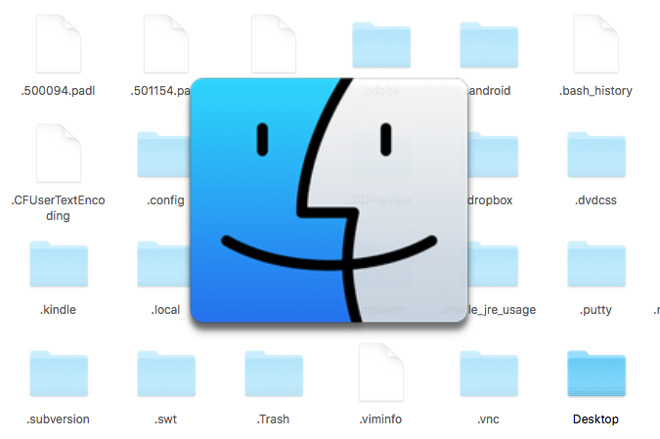
Step 5. Once you are done with this much, you can go to user deger and you will be shown all the hidden folders of the Mac OS X.
Also read: 2 Ways to Boot Your Mac in Safe Mode
Part #2: Hide Hidden Files on Mac using Terminal Command
If you wish to hide the files once again to their restricted locations, simply follow the steps from 1-5 and replace the previously entered command with the following new command in the Terminal dialog box:
defaults write com.apple.finder AppleShowAllFiles NO
You should see the hidden files/folders are not shown.
If you’re using Windows 10, it also easy to show and hide file/folders on Windows 10
Part #3: Show/ Hide Hidden Files on Mac/ Using Terminal Aliases
As per the instructions of the aforementioned method, you need to enter the commands every time you wish to show or hide the hidden security files which at times prove to be a bit hectic. Since you cannot memorize the entire code, you have to retrieve it every now and then to do your job.
Now Alias is a shortcut command for a single or multiple commands designed to render the same changes as the long commands, with an exception of cutting short your valuable time.
Step 1. From the “Finder” context menu, select “Applications” folder, and then “Utilities” folder. Inside the “Utilities” folder, you get to see “Terminal” option. Click on it to launch the “Terminal” feature.
Hide And Speak Mac Os 8
Step 2. From the Terminal interface, type in the following command:
sudo nano ~/.bash_profile
Step 3. Enter you Mac’s admin password if required and press “Enter”.
Step 4. Now; at the bottom of the opened .bash_profile file, paste the following command:
alias showFiles=’defaults write com.apple.finder AppleShowAllFiles YES; killall Finder /System/Library/CoreServices/Finder.app’
Step 7. Just below the recent command, enter this additional command also:
alias hideFiles=’defaults write com.apple.finder AppleShowAllFiles NO; killall Finder /System/Library/CoreServices/Finder.app’
Step 8. Press “Ctrl+O” key combination and hit “Enter” to save the file which is currently modified.
Step 9. Now; press “Ctrl+X” key combination to close the particular file and return to the Terminal command line dialog box again.
Step 10. In Terminal dialog box, type in the following command for it would make your alias available by refreshing your profile:
source ~/.bash_profile
Step 11. Now; if you want to make the hidden files available enter in Terminal showFiles and then hideFiles when you want to make them unavailable again.
Conclusion:
As you can see, the methods mentioned above mainly involve running commands, and thus following the 1st method often proves to be a bit time consuming, but creating the Terminal Alias would save you the trouble of cramming all the lengthy commands. To be enable to hide/ show hidden files/folder on Mac is of utmost importance if you are going to use your Mac OS X on a daily basis.
Related Articles:
This guide is about the Hide and Show the Dock in Mac OS X. I will try my best so that you understand this guide very well. I hope you all like this guide Hide and Show the Dock in Mac OS X.
The dock is one of the basic features of Mac OS X, which includes all running applications and also serves as a quick launch bar for opening applications and managing multitasking. The dock is popular and intuitive enough to be a key UI element outside of the Mac, incorporated as a major component in iOS and other operating systems.
A simple trick to improve the functionality of the dock is to hide it when the dock is not in active use. When Auto Hide is turned on, the dock only shows itself when the cursor is over the area of the Mac screen where the dock appears. This is easy to set up either by using a keyboard shortcut or by visiting Mac OS X System Preferences.
How to hide and show dock with hotkey
If you hit Command + Option + D it automatically hides or shows the dock in Mac OS X. If you choose to hide it this way, it will reappear if you hover the mouse pointer over the area where the Dock is placed.
The keyboard shortcut enables or disables auto-hide without going to System Preferences, which are discussed below:
How to hide the dock automatically when not in use on a Mac
You can set the dock to hide itself automatically when not in use, either by clicking the shortcut icon as described above or by enabling an option in the Dock Preference panel. For most Mac users, the System Preferences method is recommended:
- Open System Preferences from the Apple menu and select Dock
- Select the “Hide and show dock automatically” checkbox by clicking the checkbox next to it
If this option is selected, the dock hides and shows itself automatically when the cursor is near the bottom of the screen.
If not selected, the dock will always appear at the bottom of the Mac screen.
This setting is available in all versions of Mac OS X, whether new or old, but switching in System Preferences may be very different in earlier versions of Mac OS X, mainly because there are fewer options for customizing the Dock experience in general:
Shows the dock when it is hidden and hides the dock when it is visible
When this box is checked, the dock automatically hides itself when not in use.
To display the Dock, move the mouse pointer to the bottom of the screen.
To make the dock disappear again, move the cursor away from the bottom of the Mac screen. Easy!
This is an underused but great feature that preserves the property of the screen, making it especially valuable for Mac users with smaller screens, such as the MacBook Air and MacBook Pro.
Why is the dock automatically hidden?
Whether or not you hide the dock automatically is a matter of personal preference, but if you want to maximize your screen space, you might like the feature.
I constantly use the Dock in conjunction with Spotlight to launch apps on a Mac. However, I find that automatically hiding the dock when not in use saves me a fair amount of display properties on my MacBook Pro 13, and this is especially valuable for maximized application and web browsing.
In modern versions of Mac OS X, the Dock automatically hides itself by default when it enters full-screen application mode.
New on a Mac and Not sure about the Dock yet? Think of it as similar to the Windows taskbar, although modern versions use Dock-themed variations and are integrated with Vista, Win 7, and Windows just one of the nicest ways to launch apps quickly, whatever you use.
Benefits: Hide and Show the Dock in Mac OS X
Hide And Speak Mac Os X
- The Hide and Show the Dock in Mac OS X guide is free to read.
- We help many internet users follow up with interest in a convenient manner.
- The price of the Hide and Show the Dock in Mac OS X guide is free.
FAQ: Hide and Show the Dock in Mac OS X
Guide about Hide and Show the Dock in Mac OS X
Hide And Speak Mac Os X
How this Guide helping you?
Hide And Speak Mac Os Catalina
What are the supported devices for this guide?
What are the supported Operating system?
Final note: Hide and Show the Dock in Mac OS X
If you have any queries regards the Hide and Show the Dock in Mac OS X, then please ask us through the comment section below or directly contact us.
Education: This guide or tutorial is just for educational purposes.
Misinformation: If you want to correct any misinformation about the guide “Hide and Show the Dock in Mac OS X”, then kindly contact us.
Want to add an alternate method: If anyone wants to add more methods to the guide Hide and Show the Dock in Mac OS X, then kindly contact us.
Our Contact: Kindly use our contact page regards any help.